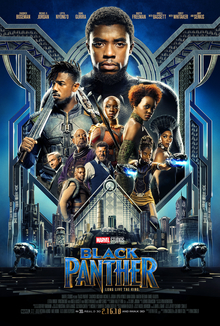
Written by Ryan Coogler, Joe Robert Cole
ProducerKevin Feige
Starring Chadwick Boseman, Michael B. Jordan, Lupita Nyong’o, Danai Gurira, Daniel Kaluuya, Martin Freeman, Letitia Wright, Winston Duke, Sterling K. Brown, Angela Bassett, Forest Whitaker, Andy Serkis
Music Ludwig Gӧransson
Cinematography Rachel Morrison

Wesley Snipes started working on a Black Panther movie back in 1992, but it never got off the ground. More than two decades later, director Ryan Coogler and actor Chadwick Boseman didn’t just bring the character to the screen; they brought him to life. After debuting in 2016’s Captain America: Civil War, T’Challa returns as the newly crowned king of Wakanda, trying to lead his nation and save the world from a dangerous new threat.
Black Panther is the eighteenth Marvel Cinematic Universe film, and the first with a predominantly black cast and a black director. Coogler, who made Fruitvale Station and Creed, takes the MCU to new heights here. He has a real gift for assembling great casts and telling emotional stories with fully realized characters and a steady tone.
Boseman is superb as T’Challa. Marvel has a knack for casting leads who simply are their characters (Downey as Stark, Evans as Cap, Hemsworth as Thor), and Boseman fits right in. His T’Challa is a young man trying to honor his people’s culture while wrestling with his own demons. He’s a good man trying to be a good king, which is harder than it sounds, and Boseman makes you feel every bit of it.
The other standout is Michael B. Jordan as Killmonger. Marvel has long struggled to give its heroes villains who are just as compelling, and Killmonger finally breaks that streak. His goals are almost justifiable, and the best villains are the ones who think they’re right. Here, he just might be, which creates conflict for T’Challa and for the audience. Jordan may even give the best performance in the film, which is saying a lot. Killmonger is the yin to Black Panther’s yang, and when the two share the screen, it hits harder than almost anything else in the MCU.
The supporting cast is just as strong. Andy Serkis returns from Age of Ultron as arms dealer Klaw, and he gets plenty of room to chew the scenery as a gleefully zany baddie. Letitia Wright debuts as T’Challa’s genius little sister, Shuri, and she’s genuinely hilarious. So is Martin Freeman’s Everett Ross, a fish out of water who can’t stop gawking at Wakanda’s technology.
The film puts a large cast of black actors in the spotlight, and its women get their moment too. Lupita Nyong’o’s Nakia and Danai Gurira’s Okoye steal every scene they’re in, and it’s more obvious than ever that Marvel should keep giving its female characters center stage.
Behind the camera, the film looks and sounds incredible. It’s gorgeously shot, with colors that pop and shine, making it one of the best-looking Marvel movies yet. The costumes match, with bold designs and hypnotic color schemes. Ludwig Göransson, on his third collaboration with Coogler, blends traditional African music with contemporary tracks for a score that feels like a tribute to the whole continent.
My biggest complaint is a small one: the CGI. A few moments look like a video game and can be a little distracting, but they’re rare and pass quickly, so it barely dents an otherwise great movie.
I was thrilled to see Marvel finally bring black and female representation to the big screen on this scale. Coogler and co-writer Joe Robert Cole crafted a fantastic story that introduced African and Black culture to a wide audience and honored it in the process. With a predominantly black cast, a black director, and black writers, Black Panther is a near-perfect film and one of the great cultural milestones in cinema.

