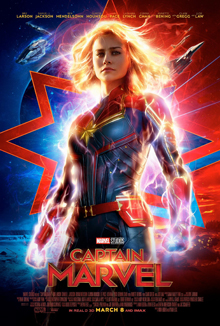
Written byAnna Boden, Ryan Fleck, Geneva Robertson-Dworet
ProducerKevin Feige
StarringBrie Larson, Samuel L. Jackson, Ben Mendelsohn, Djimon Hounsou, Lee Pace, Lashana Lynch, Gemma Chan, Annette Bening, Clark Gregg, Jude Law
MusicPinar Toprak
CinematographyBen Davis

Captain Marvel is the twenty-first Marvel Cinematic Universe film, the first with a female lead, and the first co-directed by a woman. When Black Panther came out in 2018, it blew audiences away. Its political and social nuance redefined what a superhero movie could be: not just costumed characters throwing punches, but a means to inspire and educate people about the importance of Black representation. Captain Marvel is just as important, and there’s no reason it shouldn’t have done the same for female representation in the genre. Unfortunately, it doesn’t, at least not well enough.
Set in 1995, the film follows former Air Force pilot Carol Danvers (Brie Larson), who becomes Captain Marvel after an alien race secretly invades Earth. Along the way she teams up with Nick Fury (Samuel L. Jackson) to uncover the secrets of her past.
Directors Anna Boden and Ryan Fleck have never headlined a big-budget film, and it shows. They’re simply not ready to juggle a blockbuster this size. At times it feels like something you’d catch on Syfy, and that’s not a compliment. The pacing drags even at a relatively short 124 minutes, and the tone never settles. The action is fun in theory, but between the jump cuts and the murky lighting, it’s hard to tell what’s happening on screen. If this had come out alongside 2011’s Thor and Captain America: The First Avenger, it might have sat better with me. Next to the far stronger recent Marvel releases, it feels painfully dated.
Captain Marvel may be riddled with directing, structural, and tonal problems, but Brie Larson helps pull it out of the mud. She’s already proven her chops in Room, and she’s far more likable as Carol than the trailers suggested. She has real wit and a strong personality, and she made me laugh out loud several times. But the uneven direction rubs off on the character, who also feels like she belongs in the 2011 era of Marvel films. Just as filmmakers struggled to bring Thor to life, Captain Marvel seems headed for the same fate, despite Larson’s best efforts.
Samuel L. Jackson returns as Nick Fury, now 25 years younger, and the de-aging effects are stunning. I believed it every second, and I’d love to see it used more often. Jackson is a delight, and his chemistry with Larson is a much-needed palate cleanser in an otherwise convoluted movie.
A few other performances stand out too, especially Ben Mendelsohn and Lashana Lynch. Some of the ’90s references work well, and I loved the placement of songs like No Doubt’s “Just a Girl.” There are plenty of fun nods to the rest of the MCU and a few solid jokes as well.
The film’s biggest offense might be how forgettable it is. It’s not particularly good or overwhelmingly bad. It just is, and it adds almost nothing to the franchise or the industry, when it very much should have. Beyond introducing a character who’s set to appear in Avengers: Endgame later this year, nothing here feels important to the larger MCU. Hopefully a sequel or future appearance, with more seasoned directors and writers, will give her the representation she deserves.
There’s no reason Captain Marvel shouldn’t have been one of the best characters in the MCU. It’s not because of her gender or the actress’s performance, but because of the writing and the mishandling of the character. Gal Gadot proved in 2017’s Wonder Woman that a woman could headline a comic book movie not just adequately but exceptionally, which makes it feel like a real missed opportunity that Marvel’s first female lead got a fine but forgettable slog. Despite solid work from Larson and Jackson, Captain Marvel never truly takes flight and struggles to stick the landing.
<img
